Why location strategy differs for luxury dining

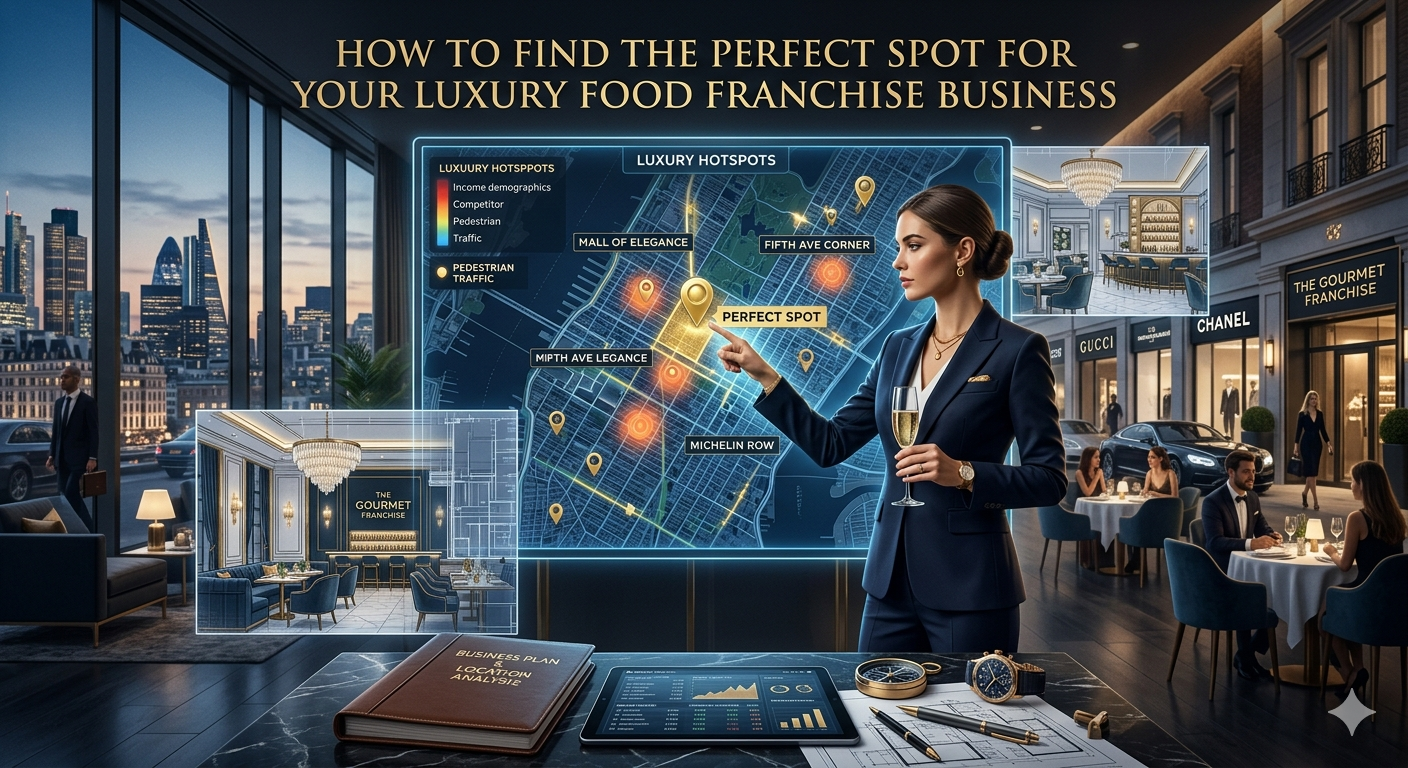
Most articles on food franchise location focus on high street visibility, proximity to office complexes, or maximum pedestrian count. This advice serves a fast-food brand well. But if you are entering the luxury dining segment, where guests book tables in advance, dress intentionally, and arrive expecting a complete experience, this calculus changes entirely.

Luxury dining guests don't stumble in. They seek you out. This means your location doesn't need to be the most crowded corner; it needs to be the most meaningful corner. It should be the one that signals the right things about who you are before a guest even opens your door.

“The name Makeba embodies rarity and uniqueness. That spirit must be woven into every detail, including the address we choose.”

The House of Makeba, Brand Philosophy

When we opened our first rooftop on IIM Road in 2018, the choice wasn't accidental. A street flanking one of India's premier management institutes drew an aspirational, well-travelled, and food-curious crowd. It was the right audience for what we were building. That single decision set the trajectory for everything that followed.

THE HOUSE OF MAKEBA BY THE NUMBERS

7: Gujarat locations

₹125 Cr: Cumulative revenue

20× Revenue growth in 6 years

₹0 External funding raised
Decode your target demographics first.

Before you look at a single property, you must define with precision “Who your ideal guest is?” In luxury dining, you are not trying to attract everyone. You are curating the whole experience for a specific kind of person.

For The House of Makeba, that person is typically between 24 and 48, urban, educated, likely to have lived in or travelled through multiple cities, curious about global flavours, and committed to a vegetarian lifestyle without any desire to compromise on elegance. This ideal customer profile shaped every location decision we made.

Questions to ask about your target demographic

  • Where do they already spend money?: Identify premium retail clusters, boutique gyms, art galleries, co-working spaces, and upscale supermarkets. Your guests live in the same ecosystem.
  • What is their dining motivation?: Celebration, business, dating, family milestone, or everyday luxury? The motivation shapes both your location type and your required space planning.
  • Are they residents or visitors? A location with strong local residential density provides repeatable footfall, i.e., guests who return every two weeks. Visitors create spikes, not sustainable growth.
  • What is their vehicle profile?: Luxury diners often arrive by car. Valet availability or dedicated parking within 100 metres is not optional; it is part of the experience before they enter.
  • What income bracket defines your addressable audience?: A city's luxury dining density typically correlates with household incomes above ₹15L per annum. Map the concentration of these households against prospective locations.

Understand Footfall, But Not All Footfall is Equal

Raw footfall numbers are seductive but dangerous. A location near a railway station might record 50,000 people passing per day. Your luxury concept might attract 80 of them. What matters is not volume, but quality and intent.

Study footfall through the lens of occasion. A quiet residential street in a premium neighbourhood with 2,000 high-intent daily passersby will outperform a chaotic commercial hub for your brand.

The former sends its residents looking for a special Tuesday dinner; the latter sends its crowds looking for a quick bite and an air-conditioned seat.

Three-footfall lenses for luxury franchise scouting

  • 01. Occasion footfall: Foot traffic that arises from nearby event venues, business districts, wedding halls, hotels, and cultural spaces. High intent and high spend potential.
  • 02. Residential density: The number of premium housing units within a 2–3 km radius. These residents become regulars, the backbone of a sustainable luxury operation.
  • 03. Aspirational adjacency: Being situated near premium brands, flagship hotels, or institutions elevates perceived positioning even before a guest tries your food.

The Brand Fit Principle

Every location tells a story about your brand. If The House of Makeba were to open in a budget retail strip between a laundry and a mobile repair shop, no amount of stunning interior design would rescue the brand impression formed the moment a guest enters the street.

Brand fit is the alignment between your concept's aesthetic, price point, aspiration, and the physical environment in which you plant it. For luxury, you need streets that are either already prestigious or visibly on the ascent.

THE “STREET REPUTATION” TEST

Walk your shortlisted street at 7 PM on a Friday. What other brands do you see? What are people wearing? What cars are parked? If the answer aligns with your aspirational guest profile, you have brand fit. If it doesn't, no lease price is low enough to justify the misalignment.

The Sindhubhavan Marg corridor in Ahmedabad, where one of our flagship outlets stands opposite the Courtyard by Marriott, exemplifies this principle. The street has earned its reputation as the city's premier dining and lifestyle destination. Being present on it communicates something about us before we serve a single dish.

Navigating the Real Estate Landscape in India

India's F&B commercial real estate market is highly fragmented, and lease terms can make or break an otherwise excellent location. Here is what franchise operators in the luxury segment must negotiate hard on.

Key lease considerations for luxury food franchises

  • Lock-in period: Negotiate a minimum five-year lock-in with a renewal option. Luxury brands take 18–24 months to establish community familiarity. You need security to allow that to happen.
  • Revenue sharing clauses: In premium malls and high-street complexes, landlords increasingly favour revenue-sharing models. Understand the threshold that triggers the share and model multiple scenarios before signing.
  • Fit-out period: For luxury interiors requiring 6–10 weeks of construction, negotiate a rent-free fit-out period. This is standard practice and should be insisted upon.
  • Exclusivity zones: Request a clause preventing the landlord from leasing adjacent or directly visible units to direct competitors within the same cuisine or price band.
  • Signage rights: Confirm your rights to exterior branding, illuminated signage, and rooftop presence (if applicable). These are non-negotiable for luxury brand visibility.
  • Floor plate and ceiling height: Luxury dining typically requires a minimum of 2,500–3,500 sq. ft., with ceilings 12 feet or higher to accommodate the spatial grandeur guests expect.

Visibility, Access, and the Arrival Experience

In luxury hospitality, the experience begins before a guest crosses your threshold. The journey from their car to your entrance, which designers call the “arrival sequence,” shapes their emotional state for everything that follows. A cramped, cluttered, or poorly lit approach will dampen anticipation even before they see your interiors.

Evaluate every prospective location for its approach quality. Is there a natural pause point like a forecourt, a landscaped entrance, or even a flight of steps that creates a moment of transition from the outside world to your world? Rooftop and multi-level formats, which are central to The House of Makeba’s design philosophy are particularly powerful here: the ascent itself creates anticipation.

Arrival experience checklist

  • Legibility: Can a first-time guest identify your entrance from 50 metres away, day or night?
  • Parking within 100m: Self-parking, valet service, or a partnership with an adjacent facility is essential.
  • Kerb presence: Is there sufficient street frontage for external branding, lighting, and a welcoming entry?
  • Safety and lighting: Premium guests, especially couples and families, will not return to a location that feels unsafe at 10 PM.
  • Vertical play: Multi-floor or rooftop access adds experiential value and social-media-worthy moments. Look for properties where this is structurally possible.

Competitive Proximity - Threat or Opportunity?

A common instinct is to avoid locations with nearby competition. In luxury dining, this instinct is often wrong. Clustering complementary premium restaurants can create a dining destination for an entire neighbourhood that guests deliberately travel to because they know the collective quality bar is high.

The key distinction is between complementary and substitutable competition. A fine-dining Italian, a premium pan-Asian, and a luxury pure-vegetarian concept in the same block each draw their own audience while amplifying the area’s overall prestige. None of them cannibalises the others.

Conversely, be cautious of locations where a direct substitute like the same cuisine type, similar pricing, and similar ambiance is already established and thriving. Here, you would be splitting a defined market rather than growing one.

“The best locations are not always the ones with no competition, they are the ones where the right kind of competition has already validated the market.”

The House of Makeba, Franchise Operations Guide

The House of Makeba Location Checklist

When our team evaluates a prospective franchise location, we apply a structured framework developed across seven successful launches. Every location must satisfy the majority of the following criteria before we proceed to lease discussions.

  • A: Demographic alignment: Premium residential or corporate density within 3 km. Addressable household incomes above ₹12L per annum.
  • B: Brand-fit street: At least 3 premium brand neighbours retail, hotel, lifestyle, or F&B - visible from the location.
  • C: Space requirements met: Minimum 2,700 sq. ft., ceiling height 12 ft+, rooftop or multi-floor potential preferred.
  • D: Parking secured: Self-park or valet within 100 metres. Parking scarcity alone has killed otherwise excellent locations.
  • E: Lease terms acceptable: 5-year lock-in, rent-free fit-out, exclusivity clause, and full signage rights confirmed before signing.
  • F: Growth corridor: The area is either established premium or demonstrably on an upward trajectory - infrastructure investment, new hotels, or retail flagships arriving.

These are not arbitrary boxes to tick. Each criterion is rooted in a lesson learned sometimes the hard way - as we expanded from one rooftop to a seven-location group. The discipline to say no to locations that don’t meet the standard has been as important to our growth as the courage to say yes to the ones that do.

OWN A PIECE OF MAKEBA

Ready to bring The House of Makeba to your city?

We are actively expanding into Indore, Jaipur, Udaipur, Mumbai, and Pune. If you have the right location and the right ambition, let’s talk.

Visit: thehouseofmakeba.com/franchise | Email: info@thehouseofmakeba.com

OWN A PIECE OF MAKEBA

Ready to bring The House of Makeba to your city?